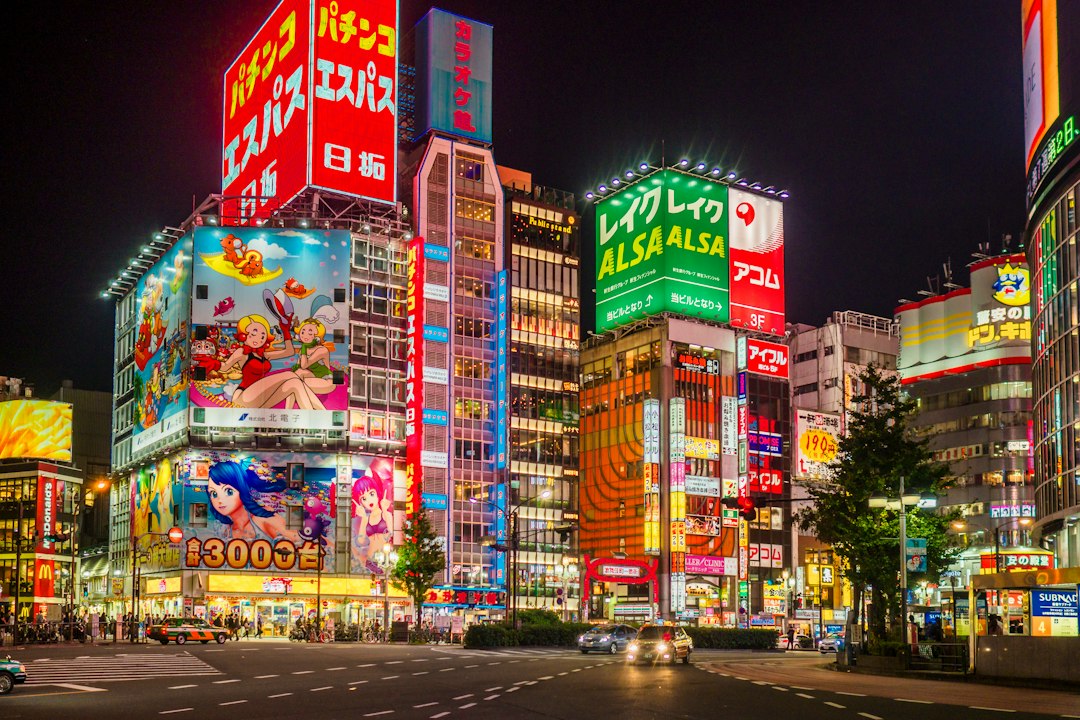
If you’re heading to Shinjuku, Shibuya, Asakusa, Dotonbori, or Gion in 2026, the scams you need to actually worry about are concentrated in about six specific situations — bar touts, fake monks, kimono rental add-ons, tax-free checkout tricks, airport SIM counters, and currency exchange margins. Japan’s overall crime rate is low, but these particular setups target tourists specifically and repeat year after year because they work. Here’s what they look like on the ground, with real locations, so you recognize them before you’re standing in the middle of one.
The Kabukicho and Dotonbori Bar Overcharge (Bottakuri)
Walk out of Shinjuku Station’s East Exit toward Kabukicho 1-chome after 9pm and you will be approached by a friendly English-speaking tout offering “all you can drink, 3,000 yen, cute girls inside.” You follow him into a building, sit down, and an hour later the bill is 28,000 yen per person because of an undisclosed table charge (sekiryō), a per-drink surcharge, and a mandatory snack plate you never ordered. The same exact script runs in Osaka near Dotonbori’s Ebisu Bridge and Soemoncho. The legitimate version of a night out in these areas is Golden Gai (Shinjuku) or Hozenji Yokocho (Osaka), where tiny bars post prices on the door — if there’s no printed price list visible from outside, don’t go in with someone who approached you on the street. If you’ve already been overcharged, pay with a credit card (never hand over cash or your card for them to run out of sight) and report it at the nearest kōban — Kabukicho has one right at the entrance to the district, literally called Kabukicho Kōban.
Fake Monks and “Free Bracelet” Donations Near Senso-ji
On Nakamise-dori leading up to Senso-ji in Asakusa, and occasionally around Harajuku’s Takeshita Street, you’ll see men in orange or saffron robes who approach solo travelers, place a bracelet or small charm in your hand, bow, and then demand a “donation” of 1,000–3,000 yen. This is not a Japanese Buddhist practice — it’s the same organized scam seen in Paris and Rome, run by non-Japanese groups exploiting the religious setting. Real Japanese monks don’t solicit money on the street this way. If someone puts something in your hand, hand it straight back and keep walking; you owe nothing. A related version on Takeshita Street involves a clipboard petition for a “children’s charity” — once you sign, they ask for a cash contribution matching the amount other (fake) signatures show above yours.
Taxi Fare Padding, Especially From the Airports
Metered taxis in Japan are generally honest, but two situations cause trouble. First, unlicensed drivers idling near nightlife exits in Dotonbori or outside Roppongi clubs around 2am who quote a flat “special price” with no meter running — this is illegal and should be an automatic red flag; always insist on a metered cab from an official taxi stand. Second, the Narita-to-central-Tokyo route: a legitimate metered ride runs roughly 20,000–25,000 yen depending on traffic and tolls, which is already steep, so some drivers pad it further by taking deliberately long routes via the Shuto Expressway during non-rush hours. Compare against the fixed-fare options (Tokyo MK Taxi and Royal Limousine both publish flat airport rates) before you get in, and if a driver’s route looks obviously indirect, pull up Google Maps on your phone — most drivers will correct course once they see you’re tracking it.
Gion Kimono Rental “Hidden Extras”
Shops along Yasaka-dori near Kiyomizu-dera advertise kimono rental from 3,500 yen, which sounds reasonable, but several shops then charge separately for hair styling (2,000–4,000 yen), accessories like obi clips and bags (1,000–2,000 yen each), and a “rush fee” if you want it before 10am. By the time you leave you’ve paid 12,000 yen for something quoted at 3,500. Okamoto Kimono Rental near Kiyomizu-dera and Yumeyakata near Kinkaku-ji are both upfront about all-inclusive pricing (full set including hair, typically 5,000–7,000 yen) — ask for the complete price in writing (or point at the number on a translation app) before you undress and commit, since once you’re half-dressed, walking out feels awkward and shops know it.
Tax-Free Shopping Tricks at Electronics Stores
As of 2026, Japan’s consumption tax is still 10% (8% on food/drink for takeaway), and tourist tax-free purchases require spending over 5,000 yen in a single store on the same day with your passport presented at checkout. The scam variant, common at smaller electronics shops in Akihabara and some counters inside larger stores like Don Quijote in Shibuya, is a “handling fee” of 1-2% deducted from your tax refund that isn’t disclosed until after the transaction, or staff who ring up the item at full price including tax and then claim the tax-free paperwork “needs to be done separately” at a kiosk that charges you again. Bic Camera and Yodobashi Camera process tax-free correctly and instantly at dedicated tax-free counters (Bic Camera Yurakucho has one on the 1st floor) — if a shop’s tax-free process involves multiple counters and separate fees, get an itemized receipt before paying.
Airport SIM and Pocket Wi-Fi Counters
Arrivals lobbies at Narita and Haneda have walk-up counters charging 1,500–2,500 yen per day for pocket Wi-Fi rental — for a 7-day trip that’s 10,500–17,500 yen. The exact same (or better) coverage pre-ordered online through Mobal, Sakura Mobile, or Ninja Wifi for pickup at the same counter runs 3,000–5,000 yen for a full week with unlimited data. It’s not technically a scam — the pricing is posted — but the markup for not having booked ahead is roughly 300%, and counter staff will not volunteer that you could’ve saved money by ordering two days earlier online.
JR Pass Resellers and IC Card Markups
Since the October 2023 price increase, the 7-day ordinary Japan Rail Pass costs 50,000 yen, 14-day is 80,000 yen, and 21-day is 100,000 yen (as of 2026 — always check jrpass.com or the JR Group’s official site before buying, since prices do get revised). Third-party sites offering the pass at a discount, or sellers on resale marketplaces offering “unused” exchange orders, are a real risk — JR will refuse a pass that doesn’t match registered purchaser ID, and you’ll be out the money at the station gate. For IC cards, avoid street vendors near Dotonbori or Kabukicho selling “special tourist Suica cards” for 2,000–3,000 yen with no stored value — the real Welcome Suica is sold directly at JR East counters in Narita and Haneda for 2,000 yen with no deposit, and as of 2025 Apple Pay Suica/Pasmo works directly with many foreign-issued Visa and Mastercard credit cards, so you may not need a physical card at all.
Currency Exchange and Dynamic Currency Conversion
Private exchange counters in Akihabara’s electronics district and around Dotonbori often post a large “NO COMMISSION” sign while baking a 7-8% margin into their exchange rate — compare against 7-Eleven’s Seven Bank ATMs, which consistently offer the best rates for foreign card withdrawals with a flat fee around 110-220 yen per transaction. Separately, when paying by credit card at hotels or department stores, the terminal will sometimes ask if you want to pay in your home currency instead of yen (Dynamic Currency Conversion) — always decline and choose JPY, since the “convenience” rate is typically 3-5% worse than what your own bank will give you.
One Timing Detail Worth Knowing
Nearly all of these scams cluster in the two-hour window between 11pm and 1am in entertainment districts, specifically targeting people who’ve already had a few drinks and are more agreeable than they’d normally be — it’s not random bad luck, it’s deliberate timing. If you’re sober, during daylight, and inside a shop with posted prices, your actual risk in Japan is close to zero; save the caution for exactly these windows and locations rather than being suspicious everywhere, which just makes the trip more stressful than it needs to be.
Photo by Alexander Schimmeck on Unsplash